
Written by
Tim Janke
,
Head of Machine Learning
Product
/
When a voice agent call goes wrong, chances are nobody notices – until a customer complains. Then the investigation starts: read the transcript, or pull the recording and listen. Both are slow, and neither scales past a handful of calls. Meanwhile the actual cause is often not the agent at all but the audio it received – a weak mobile connection, a TV running in the background, someone calling on speaker phone in a noisy environment. Teams running Tyto over their production traffic see this directly: degraded audio is a steady share of real-world calls, and it silently degrades turn-taking and speech-to-text (STT) performance alike.
Tyto exists to make that visible. It is a lightweight model that runs on an audio stream or file, before your VAD, turn-taking, STT or speech-to-speech model, and predicts whether the audio reaching your agent stack is likely to cause downstream failures. It outputs a single risk score plus a set of dimensions explaining what is driving it – live during the call to steer agent behavior, or across your call archive to get a ranked list of degraded calls. And because it runs in real time on CPU, it is cheap enough to score every call.
Since launching Tyto in June we have been working with voice AI teams running it in production, and invested in better training data, reworked training targets and a more rigorous evaluation setup. Tyto 1.1 is the result – a smaller model whose predictions track downstream failure more closely, with a refined set of dimensions.
The Tyto Risk Score
At the center of Tyto is the Tyto Risk Score: a single number between 0 and 1 that predicts how likely a piece of audio is to cause failures downstream – the higher the score, the higher the risk. Importantly, it is not a measure of how the audio sounds to a human. Perceived audio quality and machine impact are different things: a call that sounds acceptable to a human reviewer can still derail STT, and vice versa. Tyto predicts the machine impact directly, and does so independently of which STT, VAD or speech-to-speech provider you run. That makes it directly actionable: rank your archive by it to find the calls worth reviewing, track it as a fleet-wide audio-quality KPI, or react to it live, for example by adjusting VAD sensitivity, disabling barge-in, or relaying the score to the LLM so the agent itself can adapt – double-checking critical inputs like names and numbers or asking the caller to move somewhere quieter.
Quantitative evaluation
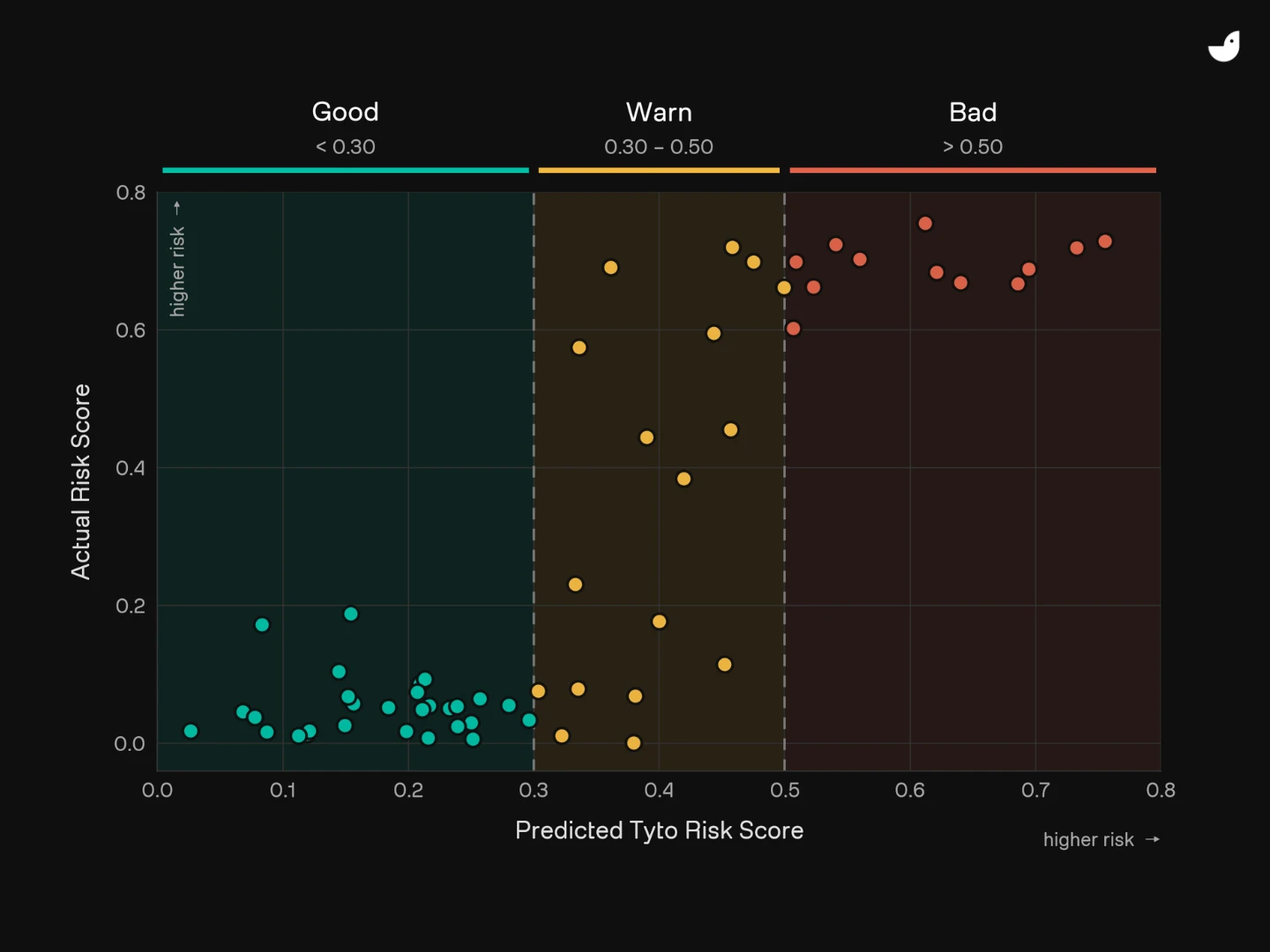
We evaluated how well the Tyto 1.1 Risk Score predicts real downstream outcomes. The chart below plots the score predicted by Tyto against the downstream impact we measured on our evaluation set. The pattern is what you want from a triage signal: below 0.3, audio is reliably uncritical for downstream models. Above 0.5, audio consistently causes failures. The band in between is mixed – some of it degrades performance, some of it doesn't.
These thresholds work in production as-is, but we recommend calibrating against your own traffic: score your audio with Tyto, rank it, and flag the top percentile for manual or more thorough QA.
The Tyto dimensions
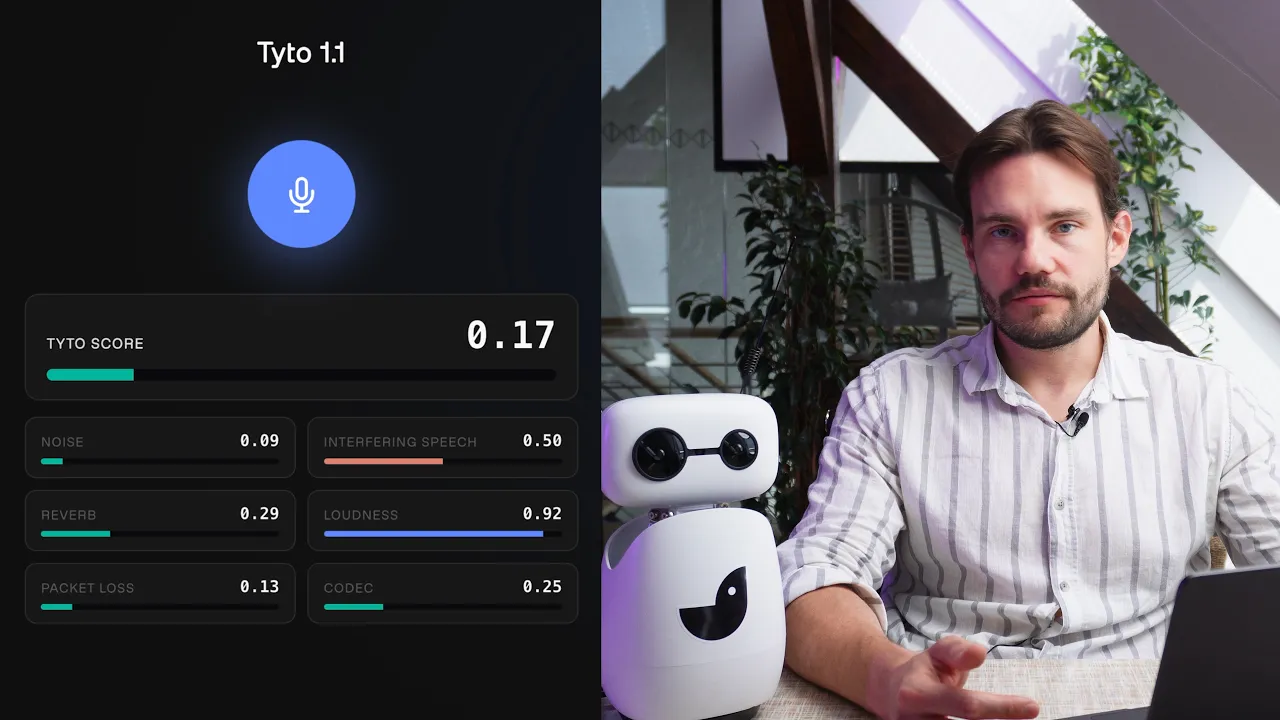
Beyond the headline Risk Score, Tyto classifies the type of degradation causing the problem. Every prediction comes with scores across six dimensions, on a 0–1 scale with higher meaning more severe. Tyto 1.1 predicts each dimension more precisely than before, and the set itself has evolved with what we observed in real deployments.
Noise (
background_noise): Ambient or environmental non-speech noise behind the speaker.Speaker Reverb (
speaker_reverb): Speaker distance and room reverberance. Low scores indicate dry, near-field audio; high scores indicate reverberant, far-field audio.Speaker Loudness (
speaker_loudness): The loudness level of the main speaker. This is the one neutral dimension constituting a level meter instead of flagging degradation.Interfering Speech (
interfering_speech): Any speech that is not the primary speaker – a person nearby, a TV, a radio. To a VAD or STT model these are the same hazard: an intelligible voice that does not belong to the interaction. Tyto 1.1 now scores them as one dimension, more accurately than the previous split between live and media sources.Packet Loss (
packet_loss): Audio dropouts or discontinuities, such as from network packet loss, jitter, frame erasure or CPU overload.Codec Degradation (
codec_degradation) – new in 1.1: Distortion introduced by the transmission chain itself. Telephony and VoIP audio routinely passes through low-bitrate codecs and transcoding steps that smear the signal. A human listener hears ordinary "phone audio"; an STT model sees a distinct failure class.
These dimensions are near-orthogonal: a call can be free of background noise yet severely degraded on packet loss or codec artifacts.
Examples
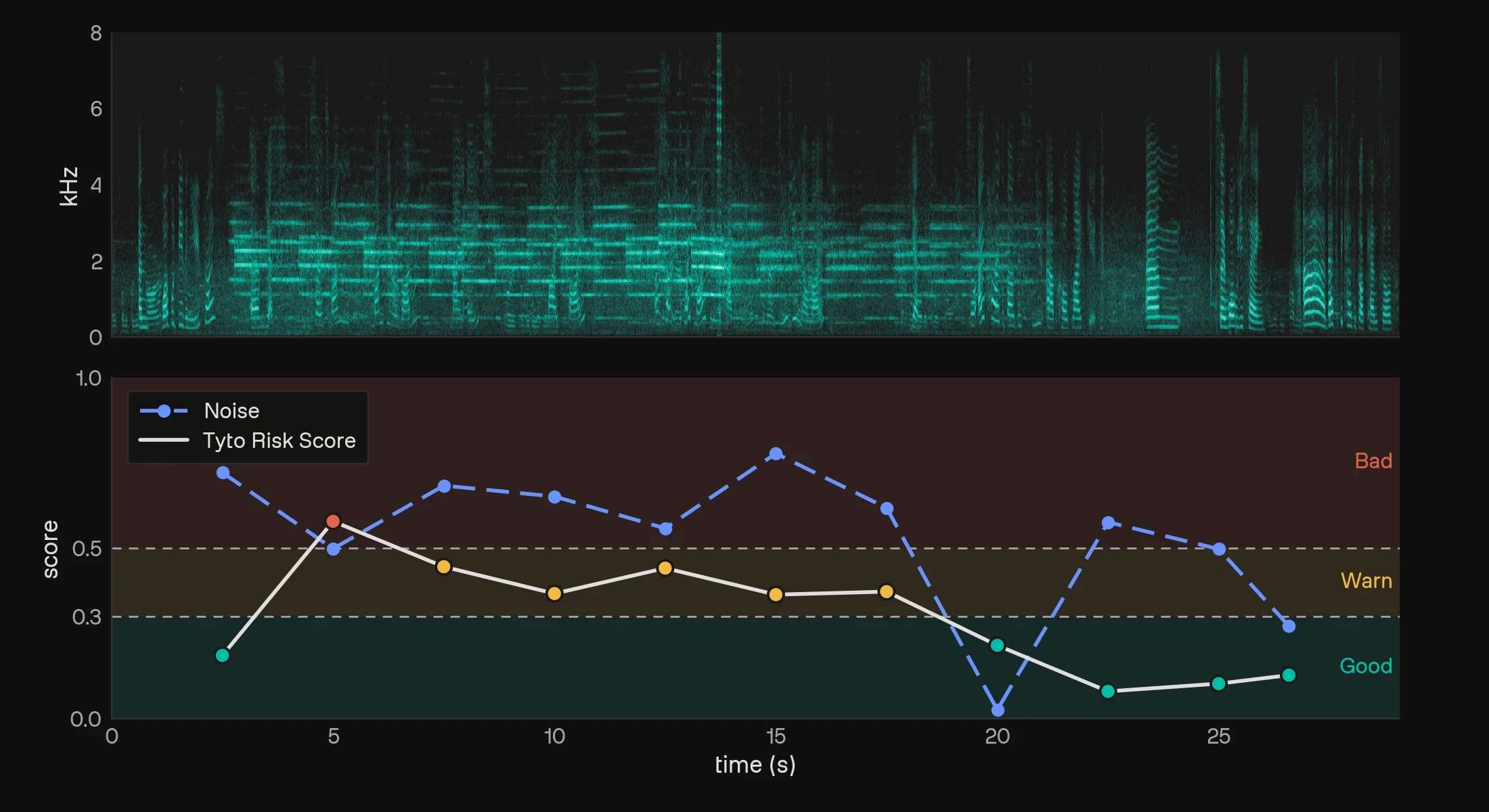
The samples below show Tyto 1.1 scores on real-world audio across different degradation types.
Want to try it on your own audio? Tyto runs in our demo applications. Try it in our developer platform.
Smaller model, every call
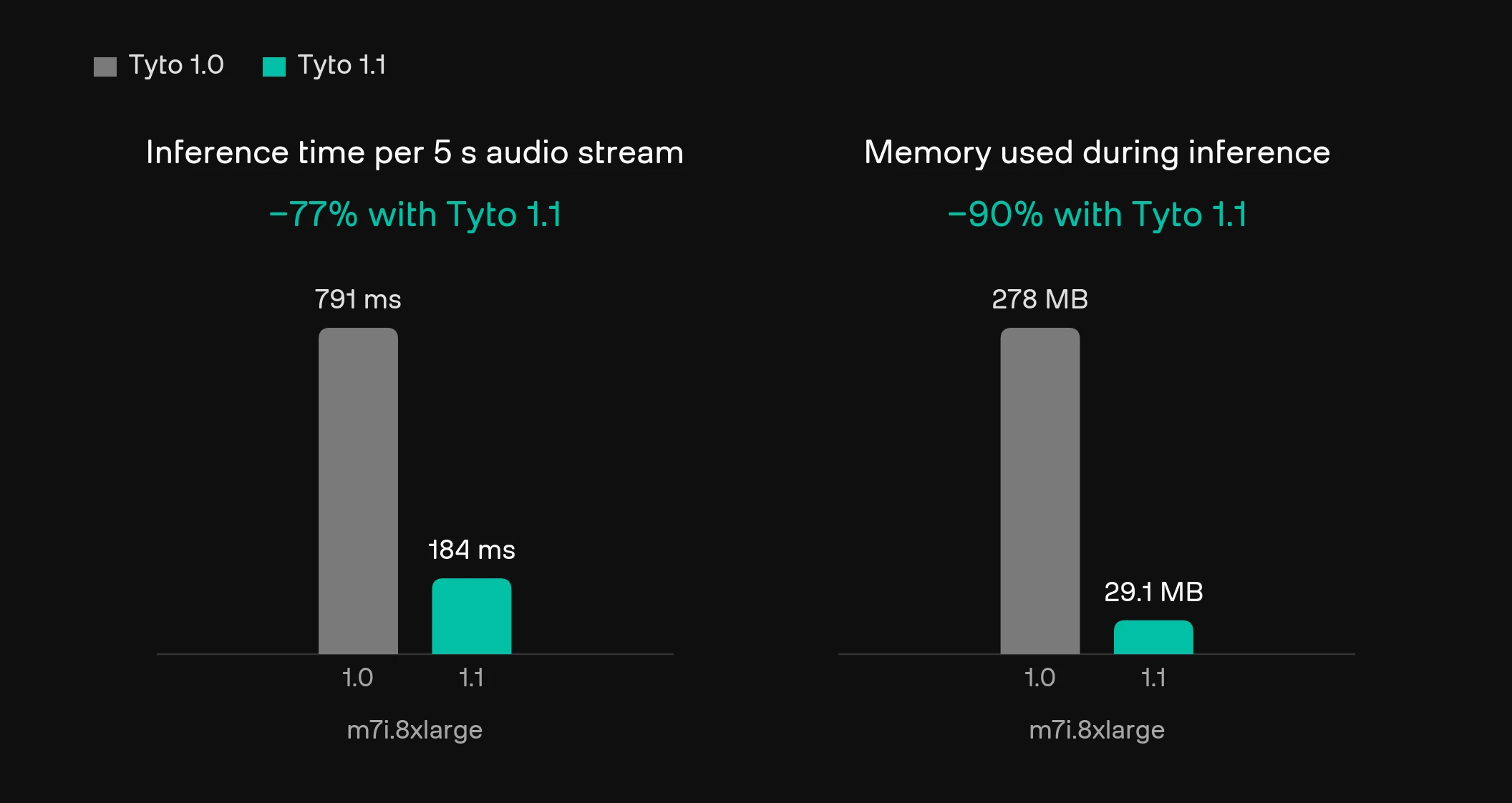
Insight only works at scale if you can afford to run it everywhere. Tyto 1.1 delivers the accuracy improvements above from a smaller model than 1.0: 77% faster inference per audio stream and 90% lower memory usage. For post-call analysis that means scanning your archive costs less; in streaming mode it means more concurrent calls per core. As before, it runs in real time on CPU via AirTen, our CPU-first inference runtime – no GPU, no ONNX – on 5-second windows at 16 kHz, on-premise if you need it, and with no reference signal required.
Try Tyto 1.1 today
Tyto 1.1 is available now in the ai-coustics SDK. If you are already running Tyto, two things change in the output. interfering_speech now covers competing speech from both live speakers and media devices such as a TV or radio, reported as a single score, so media_speech no longer appears separately. codec_degradation is new, covering lossy-codec artifacts such as Opus at a low bitrate. See the docs for output formats, integration guides and tuning advice, or talk to our team if you are running voice agents in production and want bespoke advice.