
When deploying voice agents at scale, the audio your pipeline receives rarely looks like what you tested against. Without voice isolation, background speakers, voices from media devices and echo all reach the downstream system as intelligible speech. They get transcribed alongside the primary speaker, corrupt turn-taking, and can break the agent stack entirely.
Quail Voice Focus fixes this at the source by isolating the primary speaker in real time. With Quail Voice Focus 2.2 we've made that isolation more robust across the full range of conditions real-world audio throws at it, so the right speaker comes through whatever the situation.
Why speaker isolation matters
For modern voice AI systems, noisy audio is usually not the hardest problem. The real difficulty comes when the pipeline receives multiple intelligible voices at once: the user, someone nearby, a TV or laptop in the background or echo bouncing back from the agent itself. To a VAD, ASR or speech-to-speech model, all of those can look like valid speech, and without a way to decide which voice belongs to the interaction, the context gets corrupted and conversation flow breaks.
Traditional noise suppression algorithms can't solve this. They're designed to remove non-speech sounds like hum, traffic or room ambience, not to distinguish between competing voices.
Voice Focus works differently. Instead of enhancing every voice in the mixture, it identifies the primary speaker and suppresses everything else before it reaches your downstream systems. The result is fewer stray words in the transcript, more reliable turn-taking, and less irrelevant speech entering the LLM context.
Quail Voice Focus 2.2: Reliable speaker isolation, near or far
People talk to voice agents in all kinds of ways. Some hold a phone to their ear, others put the call on speakerphone, speak to a laptop from across the desk or address an assistant from elsewhere in the room while their hands are busy. Often there is no competing voice at all, just one speaker who happens to be far from the microphone, with the natural reverberance that distance brings.
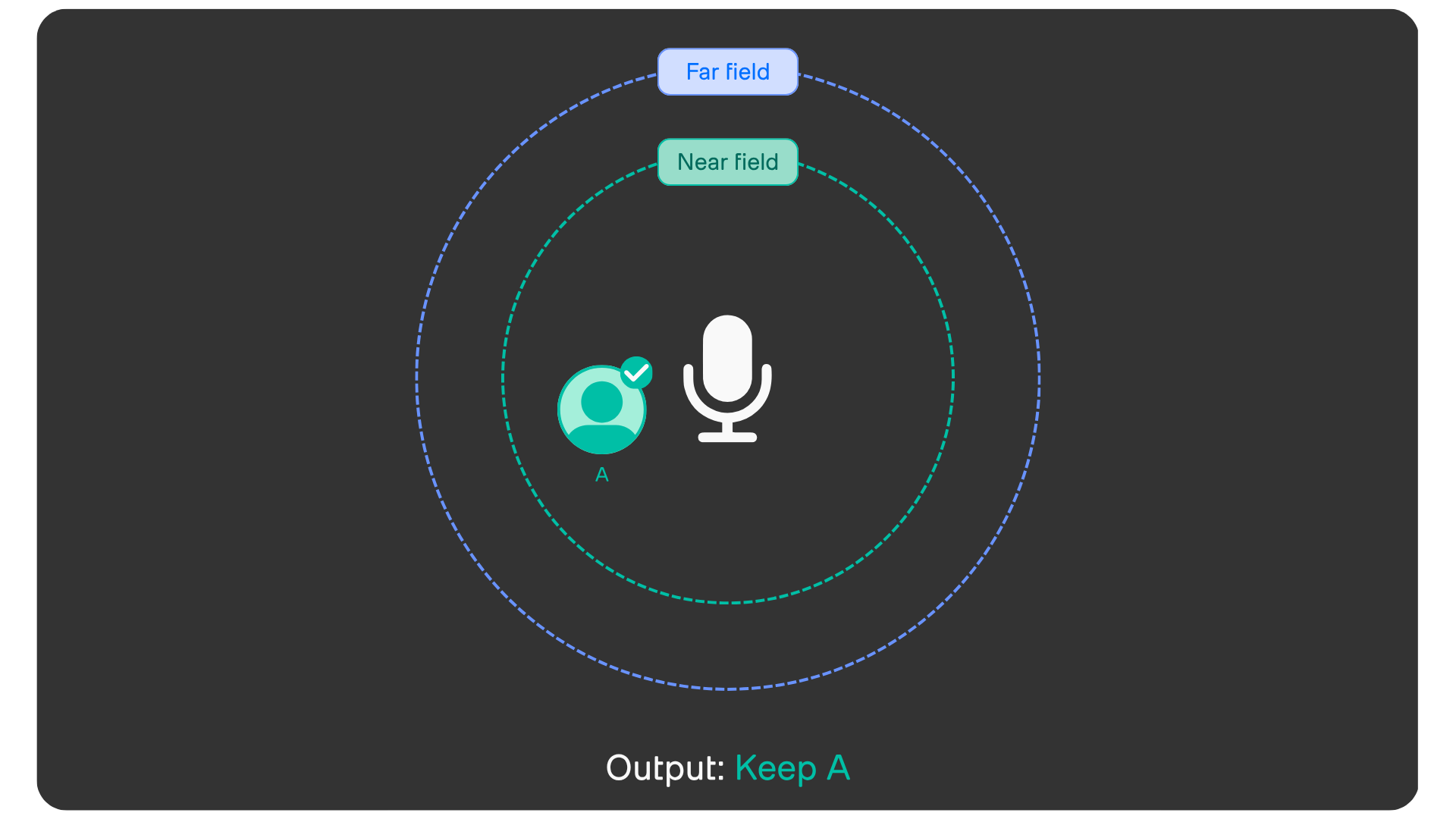
Voice Focus 2.2 improves isolation in exactly these conditions. The model identifies the dominant speaker in the scene without treating distance from the microphone as the deciding factor:
When a single speaker is the only voice present, near or far, it recognizes them as dominant and keeps them locked in clearly, instead of letting distance work against them.
When other voices compete, it preserves the strong primary speaker isolation Voice Focus 2.1 already had.
The result is a model that performs just as well on near-field and multi-speaker audio, while reliably handling far-field, single-speaker situations. The examples illustrate those three cases in practice.
Benchmarks
We evaluated Voice Focus 2.2 on a real-world dataset built around the failure cases that matter most in production, including scenes with competing speakers, media audio and echo. The chart below shows WER across seven major STT providers, with and without Quail Voice Focus 2.2. See this page for a range of qualitative examples.

On unprocessed audio, competing and stray speech create a large number of insertion errors across major STT providers. Those extra words are exactly what disrupt turn-taking and carry irrelevant content into the LLM context. Across seven major STT providers, raw audio produced WERs between 40% and 175%, with values above 100% caused by heavy insertion errors.
Quail Voice Focus 2.2 reduces WER down to 11%-18% across all providers. This substantial improvement comes from removing insertions caused by interfering speech while keeping deletions low.
Try Quail Voice Focus 2.2 today
Quail Voice Focus is our most in-demand model, and the one that teams like PolyAI, telli and Phonely rely on to keep foreground speech intact before it ever reaches their ASR or VAD. As Razvan Kusztos, VP of Engineering at PolyAI, put it: "With ai-coustics on, we've had the best customer satisfaction scores of all the tests we've done."
It comes in two sizes: S, for high call volumes, constrained infrastructure and edge deployments, and L, for the best isolation quality. Both run in real time on CPU at 30ms end-to-end latency, support 8kHz and 16kHz audio, and drop straight into your existing setup, including the native LiveKit and Pipecat integrations.
Voice Focus 2.2 is available now in the ai-coustics SDK. Test it free in under two minutes on our Developer Platform, drop it into your LiveKit or Pipecat pipeline, or talk to our team about enterprise deployments.
Why is my voice agent transcribing background speakers?
When multiple intelligible voices reach the microphone, the primary user, background talkers, media audio, echo, all of them get transcribed alongside the person you actually want, which breaks turn-taking and pollutes the LLM context with speech that was never meant for the agent. Quail Voice Focus 2.2 significantly reduces word error rates, especially driven by exactly this kind of insertion error.
What is the difference between speaker isolation and noise cancellation?
Noise suppression enhances everything in the mixture, so a second voice often survives right alongside the primary speaker. Quail Voice Focus works differently: it identifies the primary speaker specifically and isolates that voice, rather than cleaning up the whole mix and hoping the wrong speaker gets suppressed along with the noise.
Does speaker isolation work when the speaker is far from the microphone?
Far-field audio, where the speaker isn't right on top of the mic, has historically been the harder case for isolation models, since there's more room noise and reverb to separate the primary voice from. Quail Voice Focus 2.2 closes that gap, near-field and multi-speaker isolation stay strong, and far-field single-speaker audio, previously the hardest case, now performs reliably too.